
Higher education accreditation in the United States is undergoing its most significant structural shift in years and the institutions that will come out ahead aren’t necessarily the ones with the most policies on file. They’re the ones with the strongest data infrastructure.
The U.S. Department of Education’s new Accreditation, Innovation, and Modernization (AIM) Committee is signaling a clear directional shift: quality assurance will increasingly be measured by what students actually achieve, not just whether an institution followed the right procedures. For community colleges, career colleges, and trade schools participating in federal financial aid programs, this isn’t a distant policy conversation. It’s an operational challenge that starts now.
But the challenge looks different depending on where your institution is in its accreditation journey.
Two Institutions, Two Sets of Stakes
Consider two scenarios:
Institution A is a career college preparing to seek initial accreditation. Leadership understands the academic requirements, but the institution has never had to systematically collect, validate and report student outcome data at the level accreditors now expect.
Institution B is a community college with established accreditation. It has systems in place, but those systems were built around the old framework. Graduation reports live in one department, employment data in another and financial value metrics are still being reconciled after the first round of FVT submissions.
Both institutions face the same regulatory future. But their preparation gaps are fundamentally different.
For Institutions Seeking Accreditation: Build the Foundation Right
If your institution is pursuing accreditation for the first time, you have one significant advantage: you can build your data infrastructure around the new expectations from the start rather than retrofitting legacy systems.
Here’s what that means in practice.
Accreditors Will Want Evidence, Not Assurances
The AIM Committee’s proposed reforms are designed to move accreditation away from process compliance and toward demonstrated student outcomes. That means your self-study won’t simply ask whether you have a graduation tracking policy; it will ask you to show graduation trends, disaggregated by student population, over time.
The core outcome metrics you’ll need to demonstrate from day one include:
- Completion and graduation data: Who persists, who completes and in what timeframe?
- Employment outcomes: Are graduates entering fields related to their programs? What are median earnings?
- Financial value indicators: How do program results compare to debt levels and earnings benchmarks?
- Equity and disaggregation: How do outcomes vary across student subpopulations?
Your Data Has to Be Campus-Wide Before It's Accreditor-Ready
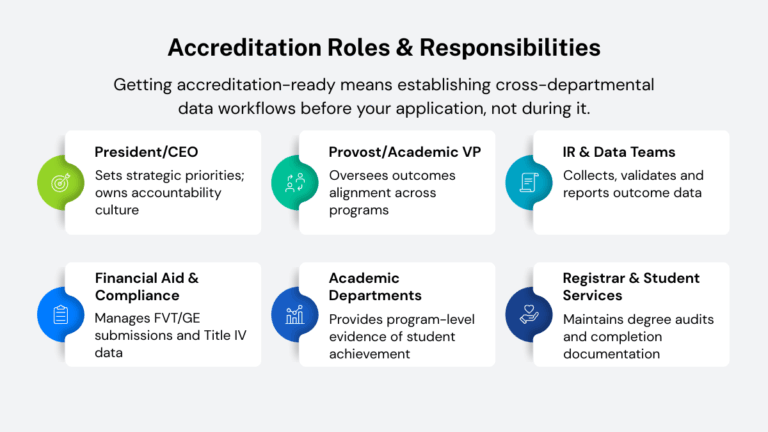
One of the most common mistakes institutions make when preparing for initial accreditation is treating outcomes reporting as an Institutional Research (IR) problem. It isn’t. By the time your IR team is assembling a self-study, the data they need has already been shaped — or compromised — by decisions made in the registrar’s office, financial aid, academic departments and student services.
The Systems That Make or Break a First Application
Degree audit and plan-of-study tools aren’t just student-facing conveniences — they’re the infrastructure behind your completion data. Accreditors will want to see that students are progressing efficiently and that your institution can document that progress systematically and at scale.
If your institution can’t generate a reliable cohort graduation report or pull program-level employment outcomes on demand, that gap will show up in your self-study before it shows up anywhere else.
For Institutions Maintaining Accreditation: The Bar Is Moving
If your institution already holds accreditation, the instinct may be to treat the AIM Committee’s work as a future concern: Something to address at the next review cycle. That instinct is worth resisting.
The regulatory changes being discussed aren’t simply additive. They represent a reframing of what “quality” means. Institutions that have historically passed accreditation reviews based on strong process documentation may find that the same evidence carries less weight going forward.
What "Data-Driven Quality Assurance" Actually Demands
The AIM Committee’s focus on student performance data as central to quality assessments has direct implications for how institutions maintain their standing. It’s no longer enough to demonstrate that outcomes are being measured. Accreditors will increasingly want to see that outcomes data is informing decisions and that institutions can show the feedback loop between data and program improvement.
That’s a harder standard to meet, and for many institutions, it will require a candid internal audit of whether current systems are actually producing actionable data or just producing reports.
Financial Value Transparency Is Already Here
While accreditation reform is still taking shape, the Financial Value Transparency (FVT) and Gainful Employment (GE) regulations are already in force. Title IV institutions must report:
- Median earnings of program completers
- Debt-to-earnings ratios
- Program-level accountability outcomes
These aren’t just compliance checkboxes. They’re becoming the empirical foundation against which accreditation evidence will be evaluated. Institutions that haven’t yet built reliable FVT/GE reporting workflows face a compounding problem: the same data gaps that create regulatory risk also create accreditation risk.
Even well-resourced institutions frequently discover the same category of vulnerabilities when they stress-test their data against new accreditation expectations:
Siloed systems. Graduation data, employment outcomes and financial value metrics exist in separate systems with no reliable way to produce a unified view of program effectiveness.
Lagging employment data. Post-completion employment outcomes are often the hardest data to collect consistently, yet they’re among the most scrutinized under both GE regulations and emerging accreditation standards.
Disaggregation deficits. Aggregate completion rates can look strong while outcomes for specific student populations (first-generation students, Pell recipients, students over 25) tell a different story. Accreditors are increasingly asking for that level of detail.
The Questions Every Administrator Should Be Asking Right Now
Regardless of where your institution sits in its accreditation journey, the AIM Committee’s work raises a set of questions that leadership should be able to answer today:
- Can we produce a program-level outcomes report — including earnings data — within 48 hours? If not, your reporting infrastructure needs attention before your next review.
- Do we know where our data lives, who owns it, and how it’s validated? Data governance isn’t just an IT concern. It’s an accreditation concern.
- Are our degree audits generating useful completion intelligence, or just serving students? The best degree audit systems do both.
- Have we stress-tested our FVT/GE submissions against our accreditation self-study evidence? Inconsistencies between the two create risk on both fronts.
- Who on our campus is responsible for telling the outcomes story and do they have what they need? Accreditation success depends on accurate data and the institutional capacity to interpret and communicate it.
The Institutions That Will Be Ready
Accreditation reform isn’t a threat to institutions that have invested in strong data governance and cross-campus collaboration. For them, it’s a validation.
The direction is clear: outcomes count more than ever, and the infrastructure required to demonstrate those outcomes — reliable degree audits, integrated reporting systems, aligned FVT and GE data — is no longer optional for institutions that want to maintain or achieve accreditation in the years ahead.
Whether your institution is building that foundation for the first time or reinforcing it before the next review cycle, the time to act is before the regulatory language is finalized. Not after.
CoreCampus helps institutions at every stage of their accreditation journey, from building the data infrastructure needed for initial accreditation to modernizing outcomes reporting for established institutions navigating new federal requirements.