Student lifecycle insights for higher education leaders
A student “stop out” is someone who pauses their education with the intention to return, as opposed to a “dropout.”
It’s important to understand that stop outs rarely happen all at once. More often, they’re the result of small issues stacking up over time: a delayed financial aid step, a confusing hold, a missed advising touchpoint or one registration cycle that becomes just hard enough to postpone.
That operational friction can be the difference between a student staying enrolled or quietly disappearing between terms.
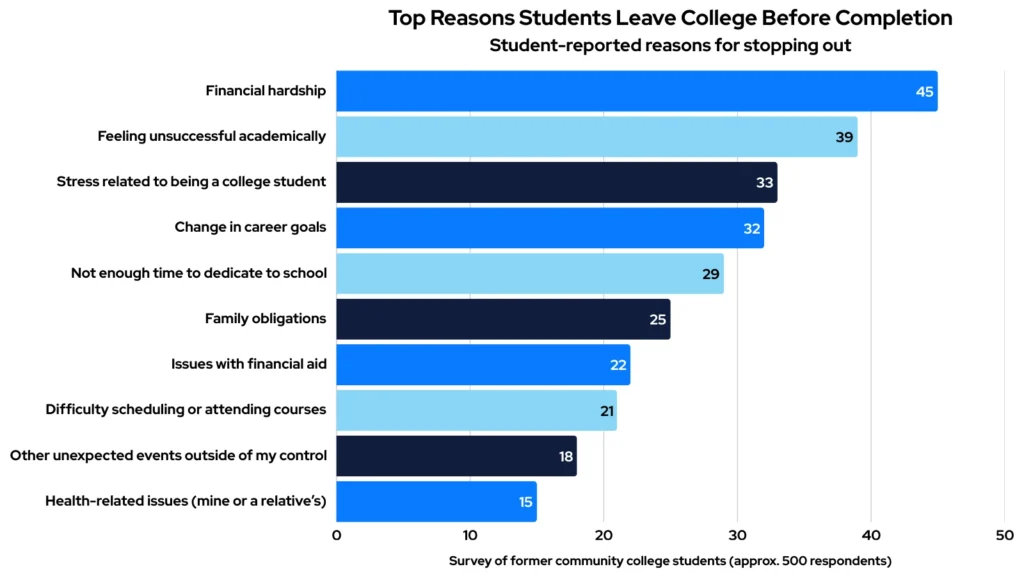
Many of the most common stop-out reasons reflect institutional and operational friction, not lack of student intent.
What’s especially telling is that these students didn’t start disengaged. Nine in 10 said they enrolled hoping to earn a credential. More than two-thirds aspired to earn a bachelor’s degree or higher. The vast majority intended to finish their courses.
In other words: students aren’t stopping out because they don’t care. They’re stopping out because the path to completion becomes too difficult to navigate when life gets complicated.
And that’s where institutions have the most leverage.
Stop Outs Are Often an Operational Problem Disguised as a Student Problem
Stop out discussions sometimes focus on motivation or grit, such as what students should do to persist.
But the data point toward a different reality: stopping out is often triggered by system-level breakdowns, including unclear processes, delayed decisions, fragmented support and a lack of visibility into what students need next.
That’s why stop out reduction isn’t just a retention initiative. It’s also an operations initiative.
For registrars in particular, this framing matters, because the registrar’s office sits at the crossroads of:
Registration and enrollment access
Academic records and degree progress
Holds and compliance requirements
Program requirements and course sequencing
Institutional policy and student-facing reality
When these systems work smoothly, students keep moving.
When they don’t, even highly motivated students can stall.
Registrars: Why This Lands on Your Desk
Registrars often see stopouts downstream (missing re-enrollment, failed registration attempts, abandoned schedules). But the causes typically appear upstream in holds, prerequisites, course demand, policy friction and unclear workflows students can’t navigate alone.
The Stop Out Risk Map: Where Students Lose Momentum
One of the most useful shifts institutions can make is moving from reactive stop out response to proactive stop out prevention. That begins with identifying where stop out risk most commonly appears in the student lifecycle:
1) Financial Uncertainty
Students may hesitate to register when they don’t understand their balance, aid status or payment expectations. “I’ll deal with it later” becomes “I missed the deadline.”
2) Academic Pathway Drift
Students who don’t have a clear plan – especially in the first term or first year – are more likely to veer off track and struggle to regain momentum.
3) Registration Friction
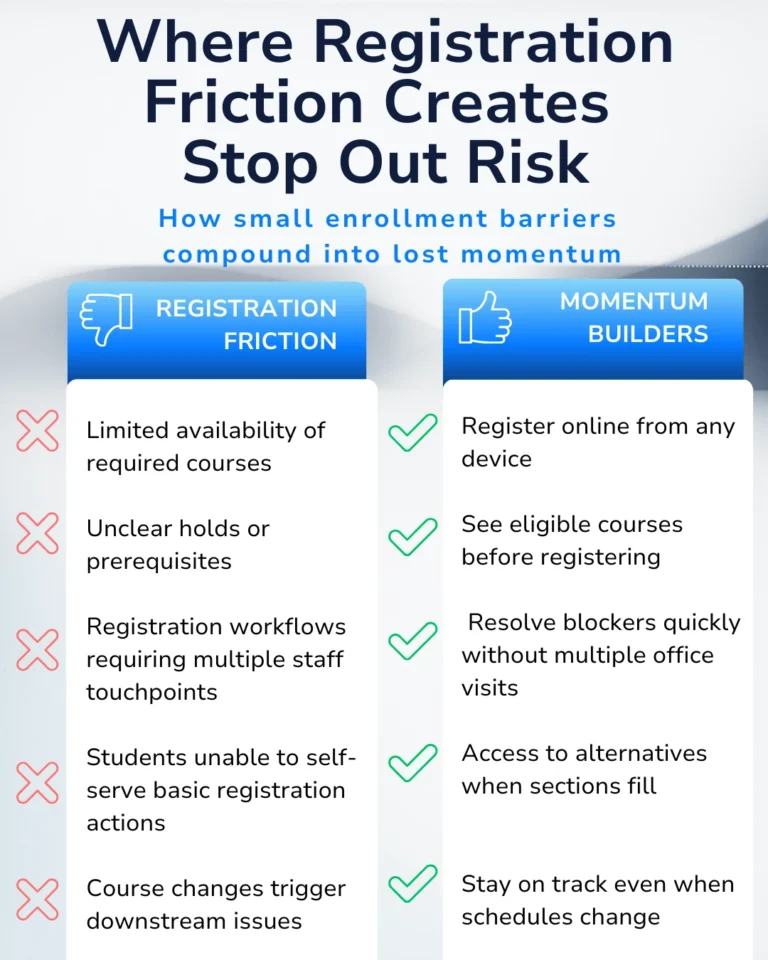
Holds, full courses, confusing prerequisites or scheduling conflicts can turn enrollment into a multi-step obstacle course. For students juggling work and family, that extra effort can be a deal-breaker.
4) Hidden Risk Signals
At-risk patterns often show up early: drops, missing requirements, nonattendance, failing grades or repeated incomplete tasks. But if no one sees those signals in time, or no one owns the next step, students slip through.
Registrars: The “Didn’t Return” Isn’t the Root Cause
Most stopouts don’t start with a decision to leave. They start with a failed attempt to continue: a block, a delay or a requirement the student didn’t know existed until it was too late.
What Effective Intervention Actually Looks Like
When schools talk about intervention, the default idea is often “more outreach.”
But more communication isn’t always more support, especially when students are already overwhelmed. The strongest interventions typically share three traits:
Earlier Visibility
The institution can identify risk while there’s still time to change the outcome.
Clear Ownership
It’s obvious who takes action: financial aid, advising, registrar, student accounts or a coordinated team.
Reduced Student Effort
The student doesn’t have to chase answers across multiple offices. The process is understandable and doable.
This is where technology can help, but only when it reinforces good operations instead of adding new complexity.
Financial Friction Is a Stop Out Trigger Institutions Can Address Quickly
Financial hardship was the top cited reason students stopped out in the study (45%). And “issues with financial aid” showed up as well.
But financial stop outs aren’t only about whether a student can pay. They’re also about whether the next step is clear.
When students face uncertainty – whether it’s about aid eligibility, missing documents, balances, deadlines or payment plans – they often respond by delaying. And delay is one of the most common pathways to stop-out.
What Schools Can Improve Operationally
A strong financial experience requires more than processing aid faster. It requires making the financial picture easier for students to understand and act on, such as:
Clear, real-time visibility into balances and aid status
Fewer steps to complete payment actions
Reduced reliance on in-person or phone-based problem-solving
Faster handoffs between financial aid, student accounts and registration
Registrars: Holds Should Be a Resolution Path, Not a Dead End
Holds can protect compliance, but they can also quietly trigger stop outs when they’re hard to interpret or require multiple office visits. If students can’t resolve a hold quickly, they often don’t resolve it at all.
Academic Support Works Best When It’s Structured, Not Just Available
In the study, one-third of surveyed stopout students reported changing career goals. That doesn’t necessarily indicate failure, but it reflects reality for many community college students who evolve their plans based on work, finances and life circumstances.
But that flexibility needs structure.
Pathway changes become stop out risk when students don’t know what to take next, can’t access the right resources quickly or lose time due to unclear requirements.
The study also pointed to gaps in advising connections:
One-quarter of students who stopped out said they never met with an advisor
Two-thirds said they never met their assigned advisor
61% said they didn’t develop an academic plan with an advisor during their first year
These numbers reflect more than advising availability, they point to a lack of scalable planning infrastructure.
What Scalable Academic Planning Looks Like
Institutions reduce stop outs when students can clearly answer:
When students don’t understand requirements, they bounce between offices and lose time. Clear progress-to-completion visibility reduces last-minute exceptions, manual overrides, and student frustration.
Registration Experience Is a Retention Strategy
Registrars already know this: students can be motivated and still stop out if registration becomes too difficult.
When required courses are full, schedule options don’t align with work obligations, or holds are confusing to resolve, students can quickly fall off the rails.
This is especially true when students have only a narrow window to enroll. Any delay can push them into the next term, which often becomes “maybe never.”
Registration experience directly shapes student persistence. Operational clarity during registration helps students keep moving forward.
Risk Indicators Only Help If They Lead to Action
Most institutions already have the data that predicts stop out risk. It’s not missing information, it’s missing coordination.
The issue is often that risk signals live in separate places:
Attendance and grades in one system
Registration and holds in another
Financial aid status in another
Student engagement in spreadsheets and emails
When staff have to manually connect the dots, response becomes slow and inconsistent. A better approach is building shared visibility and standardized follow-up so students don’t get lost between departments.
That means risk signals should trigger:
Clear next steps
Consistent ownership
Coordinated communication
Repeatable processes that don’t depend on individual heroics
Stop out prevention isn’t “work harder.” It’s building processes that surface risk early and make support predictable, especially during peak enrollment and deadline periods.
The Core Message: Stop Out Reduction Starts With Systems That Make It Easier to Persist
Students often begin with strong motivation and clear goals. But persistence isn’t only personal, it’s also structural.
When institutions reduce friction across financial processes, academic planning and registration workflows, they create conditions where students can stay enrolled even when life gets hard.
Stopping out will always be a reality in higher education. But many stop outs are preventable, not through bigger messaging campaigns, but through smarter operations.
Without a clear path to graduation, students are at increased risk of dropping out or withdrawing. Explore how the CoreCampus plan of study feature enhances the academic advising process and empowers students to take ownership of their educational journey.
Stop Out FAQs
How does the CoreCampus platform help reduce student stop outs?
CoreCampus helps registrars reduce stop outs by centralizing student records, registration workflows and academic requirements in one system. The platform provides clear visibility into holds, enrollment barriers and academic records so issues can be resolved before students disengage.
What role does student retention software play in preventing stop outs?
Student retention software helps teams identify at-risk students early by analyzing academic performance, attendance and engagement data. With real-time insight and automated alerts, advisors and registrars can act before challenges escalate into stops. Early warning triggers and retention scoring help teams coordinate support, prioritize outreach and tailor interventions to individual needs, increasing the likelihood students stay on track.
Why is a student plan of study important for reducing stop outs?
A student plan of study gives students a clear roadmap to completion by outlining required courses, sequencing and milestones. When students understand what comes next and how changes affect progress, they are less likely to stall or disengage.
How does degree audit software help stop students from stopping out?
Degree audit software tracks progress toward degree requirements and alerts staff and students when courses or credits are missing. By providing easy-to-read progress reports and what-if scenarios, degree audit tools help ensure students register for the right classes at the right time. This reduces enrollment errors and helps advisors guide students back on track before confusion or unmet requirements lead to disengagement.
Can advising software help prevent stop outs?
Advising software supports regular, informed interactions between students and advisors by centralizing notes, plans and progress tracking. When advising is consistent and visible, students are more likely to stay engaged and on track.


 Registrars: Why This Lands on Your Desk
 Registrars: Why This Lands on Your Desk
 Registrars: Degree Progress Visibility Reduces Administrative Ping-Pong
 Registrars: Degree Progress Visibility Reduces Administrative Ping-Pong